On spectral properties of some Chebyshev-type methods. Dimension vs. structure

Abstract

The aim of the present paper is to analyze the non-normality of the matrices (finite dimensional operators) which result when some Chebyshev-type methods are used in order to solve second order differential two-point boundary value problem.

We consider in turn the classical Chebyshev-tau method as well as two variants of the Chebyshev-Galerkin method. As measure of non-normality we use the non-normality ratio introduced in a previous paper. The competition between the dimension of matrices (the order of approximation) and their structure (the numerical method itself) with respect to normality is the core of our study.

It is observed that for quasi normal matrices, i.e., non-normality ratio close to 0, exhibiting pure real spectrum, this measure remains the unique indicator of non-normality. In such cases the pseudospectrum tells nothing about non-normality.

Authors

C.I. Gheorghiu
Tiberiu Popoviciu Institute of Numerical Analysis

Keywords

Non-normal matrices; scalar measure; Chebyshev spectral approximation; two point boundary value problem.

References

See the expanding block below.

Cite this paper as

C.I. Gheorghiu, On spectral properties of Chebyshev-type methods. Dimensions vs. structure, Studia Univ. Babeş-Bolyai Math., (2005) 61-66.

PDF

About this paper

Publisher Name

Babes-Bolyai University

Print ISSN

0252-1938

Online ISSN

2065-961x

MR

?

ZBL

?

Google Scholar

?

[1] Gheorghiu, C.I., A new Scalar Measure on Non-normalityApplication to the Characterization of some Spectral Methods,  under evaluation at SIAM J. Sci. Comput,
[2] Gheorghiu, C.I., Pop, I.S., On the Chebyshev-tau approximation for some Singularly Perturbed Two-Point Boundary Value Problems,  Rev. d’Analyse Numerique et de Theorie de l’Approximation, 24(1995), 125-129.
[3] Gottlieb, D., Orszag, S.A., Numerical Analysis of Spectral Methods: Theory and Applications, SIAM Philadelphia, 1977.
[4] Pop, I. S., Numerical approximation of differential equations with spectral methods (in Romanian), Technical report “Babes-Bolyai” University Cluj-Napoca, Faculty of Mathematics and Informatics, Cluj-Napoca, 1995.
[5] Pop, I.S. A stabilized approach for the Chebyshev-tau method, Studia Univ. “Babes-Bolyai”, Mathematica, 42(1997), 67-79.
[6] Pop, I.S., Gheorghiu, C.I., Chebyshev-Galerkin Methode for Eigenvalue Problems,Proceedings of ICAOR, Cluj-Napoca, 1996, vol. II, 217-220.
[7] Shen, J., Efficient spectral-Galerkin method II, Direct solvers of second and fourth equations using Chebyshev polynomials, SIAM J. Sci. Stat. Comput., 16(1995), 74-87.
[8] Trefethen, L.N., Computation of Pseudospectra, Acta Numerica, 1999, 247-295.

?

Paper (preprint) in HTML form

2005-C-Gheorghiu

ON SPECTRAL PROPERTIES OF SOME CHEBYSHEV-TYPE METHODS DIMENSION VS. STRUCTURE

CĂLIN-IOAN GHEORGHIU

Abstract

The aim of the present paper is to analyze the non-normality of the matrices (finite dimensional operators) which result when some Chebyshev-type methods are used in order to solve second order differential two-point boundary value problems. We consider in turn the classical Chebyshev-tau method as well as two variants of the Chebyshev-Galerkin method. As measure of non-normality we use the non-normality ratio introduced in a previous paper. The competition between the dimension of matrices (the order of approximation) and their structure (the numerical method itself) with respect to normality is the core of our study. It is observed that for quasi normal matrices, i.e., non-normality ratio close to 0 , exhibiting pure real spectrum, this measure remains the unique indicator of non-normality. In such cases the pseudospectrum tells nothing about non-normality.

1. Introduction

With the scalar measure of non-normality introduced in our paper [1] we try to quantify the non-normality of three Chebyshev-type methods corresponding to differential operators involved in a second order two-point boundary value problem. To be more specific we work with Chebyshev-tau method (CT for short), a Chebyshev-Galerkin method suggested by J. Shen (CGS for short) in his paper [7],
and a Chebyshev-Galerkin method (CG for short) with different trial and test basis functions analyzed in our previous papers [5], [4], [2] and [6].
In the most significant cases we also display the corresponding pseudospectra. We want to point out the fact that, besides the pseudospectra, our scalar measure of non-normality can be thought of as a fairly reasonable characteristic of non-normality of square matrices. More, it has an important advantage. By use of this scalar measure the matrices, and consequently the numerical methods, can be compared.

2. The non-normality of CT, CGS and CG methods

In order to quantify the non-normality of the first three differential operators when they are discretized using the above mentioned methods we consider the following two-point boundary value problem:
(1) u + μ u λ u = f ( x ) , u ( 1 ) = u ( 1 ) = 0 (1) u + μ u λ u = f ( x ) , u ( 1 ) = u ( 1 ) = 0 {:(1)u^('')+mu*u^(')-lambda*u=f(x)","quad u(-1)=u(1)=0:}\begin{equation*} u^{\prime \prime}+\mu \cdot u^{\prime}-\lambda \cdot u=f(x), \quad u(-1)=u(1)=0 \tag{1} \end{equation*}(1)u+μuλu=f(x),u(1)=u(1)=0
It is well known that a matrix is non-normal if it does not commute with its conjugate transpose, i.e., A A A A 0 A A A A 0 A^(**)A-AA^(**)!=0A^{*} A-A A^{*} \neq 0AAAA0 - the null matrix. We recall that for a square (non null) matrix A A AAA of dimension N N NNN with complex entries, its non-normality ratio, introduced in [1], reads as follows
H ( A ) := ε ( A A A A ) ε ( A ) H ( A ) := ε A A A A ε ( A ) H(A):=(sqrt(epsi(A^(**)A-AA^(**))))/(epsi(A))H(A):=\frac{\sqrt{\varepsilon\left(A^{*} A-A A^{*}\right)}}{\varepsilon(A)}H(A):=ε(AAAA)ε(A)
where * stands for the conjugate transpose of A A AAA and ε ( A ) ε ( A ) epsi(A)\varepsilon(A)ε(A) means the Frobenius norm of A A AAA. This is indeed a scalar measure (see [1]) and it satisfies the sharp inequality
0 H ( A ) 2 4 0 H ( A ) 2 4 0 <= H(A) <= root(4)(2)0 \leq H(A) \leq \sqrt[4]{2}0H(A)24
For the classical CT method we refer to the well known monograph Gottlieb and Orszag [3], pp. 119-120.
For the CGS method we found out the matrices from the paper [7] P. 4.
Eventually, all the technicalities implied by CG method are available in the report of I. S. Pop [4]. For various values of parameters μ μ mu\muμ and λ λ lambda\lambdaλ the non-normality ratios are displayed in the following three tables.
N = 8 N = 8 N=8\mathrm{N}=8N=8 N = 64 N = 64 N=64\mathrm{~N}=64 N=64 N = 128 N = 128 N=128\mathrm{~N}=128 N=128 N = 512 N = 512 N=512\mathrm{~N}=512 N=512 The variation
CT 1.0254 0.9852 0.9847 0.9845 rarr\rightarrow
CG 0.3958 0.2220 0.1616 0.0825 \searrow
CGS 0.2926 0.1238 0.0891 0.0452 \searrow
N=8 N=64 N=128 N=512 The variation CT 1.0254 0.9852 0.9847 0.9845 rarr CG 0.3958 0.2220 0.1616 0.0825 ↘ CGS 0.2926 0.1238 0.0891 0.0452 ↘| | $\mathrm{N}=8$ | $\mathrm{~N}=64$ | $\mathrm{~N}=128$ | $\mathrm{~N}=512$ | The variation | | :---: | :---: | :---: | :---: | :---: | :---: | | CT | 1.0254 | 0.9852 | 0.9847 | 0.9845 | $\rightarrow$ | | CG | 0.3958 | 0.2220 | 0.1616 | 0.0825 | $\searrow$ | | CGS | 0.2926 | 0.1238 | 0.0891 | 0.0452 | $\searrow$ |
Table 1: The non-normality ratios for mu = 0 mu = 0 mu=0\mathrm{mu}=0mu=0. and lambda = 0.1 = 0.1 =0.1=0.1=0.1 in (1).
N = 8 N = 8 N=8\mathrm{N}=8N=8 N = 64 N = 64 N=64\mathrm{~N}=64 N=64 N = 128 N = 128 N=128\mathrm{~N}=128 N=128 N = 512 N = 512 N=512\mathrm{~N}=512 N=512 The variation
CT 0.0510 0.9713 0.9845 0.9845 rarr\rightarrow
CG 0.3584 0.1359 0.0986 0.0728 \searrow
CGS 0.0076 0.0121 0.0200 0.0538 \nearrow
N=8 N=64 N=128 N=512 The variation CT 0.0510 0.9713 0.9845 0.9845 rarr CG 0.3584 0.1359 0.0986 0.0728 ↘ CGS 0.0076 0.0121 0.0200 0.0538 ↗| | $\mathrm{N}=8$ | $\mathrm{~N}=64$ | $\mathrm{~N}=128$ | $\mathrm{~N}=512$ | The variation | | :---: | :---: | :---: | :---: | :---: | :---: | | CT | 0.0510 | 0.9713 | 0.9845 | 0.9845 | $\rightarrow$ | | CG | 0.3584 | 0.1359 | 0.0986 | 0.0728 | $\searrow$ | | CGS | 0.0076 | 0.0121 | 0.0200 | 0.0538 | $\nearrow$ |
Table 2: The non-normality ratios for mu = 0 mu = 0 mu=0\mathrm{mu}=0mu=0. and lambda = 256 2 = 256 2 =256^2=256^{\wedge} 2=2562 in (1).
N = 8 N = 8 N=8\mathrm{N}=8N=8 N = 64 N = 64 N=64\mathrm{~N}=64 N=64 N = 128 N = 128 N=128\mathrm{~N}=128 N=128 N = 512 N = 512 N=512\mathrm{~N}=512 N=512 The variation
CG 0.4759 0.1972 0.1435 0.0796 \searrow
CGS 0.1979 0.0628 0.0538 0.0414 \searrow
N=8 N=64 N=128 N=512 The variation CG 0.4759 0.1972 0.1435 0.0796 ↘ CGS 0.1979 0.0628 0.0538 0.0414 ↘| | $\mathrm{N}=8$ | $\mathrm{~N}=64$ | $\mathrm{~N}=128$ | $\mathrm{~N}=512$ | The variation | | :---: | :---: | :---: | :---: | :---: | :---: | | CG | 0.4759 | 0.1972 | 0.1435 | 0.0796 | $\searrow$ | | CGS | 0.1979 | 0.0628 | 0.0538 | 0.0414 | $\searrow$ |
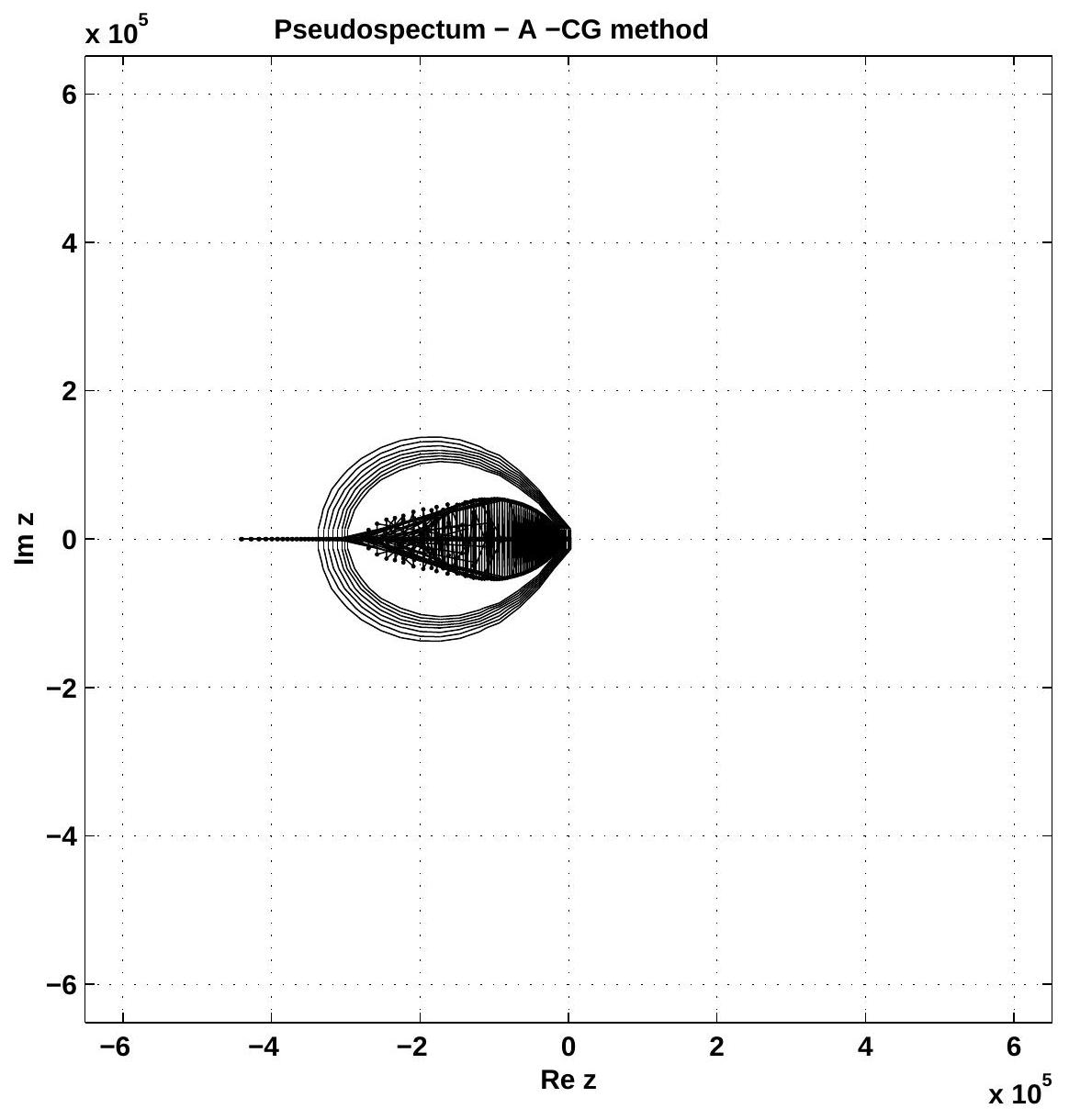
Table 3: The non-normality ratios for mu = 256 mu = 256 mu=256\mathrm{mu}=256mu=256. and lambda = 0.1 = 0.1 =0.1=0.1=0.1 in (1).
It is well known that the non-normality of matrices is also investigated using the notion of pseudospectrum i.e., the spectrum of the randomly perturbed matrix with an arbitrary small quantity. Up to our knowledge a direct connection between scalar measures of non-normality and pseudospectra does not exist.
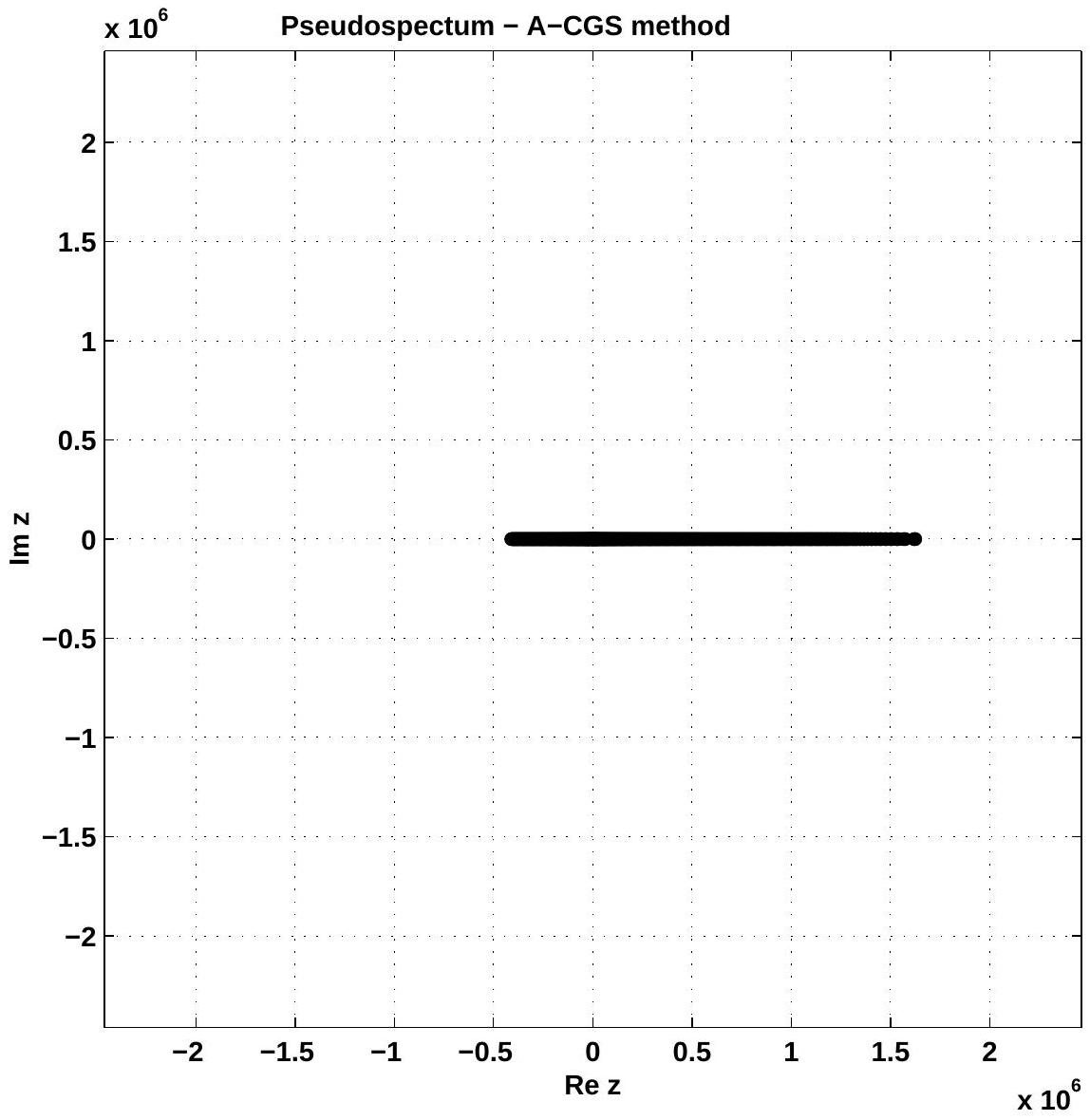
For example, the pseudospectra reported in Figures 1 and 2 look very different even if they correspond to matrices with close values of non-normality ratios.
While for the CG method the spectrum contains complex eigenvalues, and the pseudospectrum underlines the spectral instability, in case of CGS method all eigenvalues are pure real and the spectral instability is almost absent. Thus, in spite of the fact that a matrix is non-normal, its pseudospectrum does not perceive this anomaly. In this situation we must resort to a scalar measure in order to observe the non-normality. We also observe that the complex part of the spectrum is much more instable than the real counterpart.
Figure 1. The pseudospectrum corresponding to position 2, 4 in Table 2
Remark 1. A Matlab code was used in order to work out the entries of Tables 1,2 and 3. The pseudospectra were depicted using a slightly modified code from the paper of L. N. Trefethen [8].
Figure 2. The pseudospectrum corresponding to position 3, 4 in Table 2

3. Concluding remarks

First of all, it is very clear from Tables 1 and 2 that the CT method is worse with respect to normality and its non-normality does not vary with the dimension N N NNN of the approximation.
The most normal method seems to be CGS. Anyway, for large N N NNN the CG and CGS methods become closer and closer. At the same time, it is quite surprising that in the absence of the first order term (see Table 3) these methods seem to converge to
the same value of non-normality, CG decreasing and CGS increasing for large values of cutoff parameter N N NNN.
Finally, we have to remark that in spite of the fact that in cases considered in Figures 1 and 2 the non-normality ratios are quite closed, the pseudospectra are incomparable. It seems that in such cases the information furnished by pseudospectrum could be misleading.

References

[1] Gheorghiu, C. I., A new Scalar Measure on Non-normality. Application to the Characterization of some Spectral Methods, under evaluation at SIAM J. Sci. Comput.
[2] Gheorghiu, C. I., Pop, I. S., On the Chebyshev-tau Approximation for some Singularly Perturbed Two-Point Boundary Value Problems, Rev. d'Analyse Numerique et de Theorie de l'Approximation, 24(1995), 125-129.
[3] Gottlieb, D., Orszag, S. A., Numerical Analysis of Spectral Methods: Theory and Applications, SIAM Philadelphia, 1977.
[4] Pop, I. S., Numerical approximation of differential equations with spectral methods (in Romanian), Technical report, "Babes-Bolyai" University Cluj-Napoca, Faculty of Mathematics and Informatics, Cluj-Napoca, 1995.
[5] Pop, I. S., A stabilized approach for the Chebyshev-tau method, Studia Univ. "BabesBolyai", Mathematica, 42(1997), 67-79.
[6] Pop, I. S., Gheorghiu, C. I., Chebyshev-Galerkin Methods for Eigenvalue Problems, Proceedings of ICAOR, Cluj-Napoca, 1996, vol. II, 217-220.
[7] Shen, J., Efficient spectral-Galerkin method II, Direct solvers of second and fourth equations using Chebyshev polynomials, SIAM J. Sci. Stat. Comput., 16(1995), 74-87.
[8] Trefethen, L. N., Computation of Pseudospectra, Acta Numerica, 1999, 247-295.
"T. Popoviciu" Institute of Numerical Analysis, P.O. Box 68, Cluj-Napoca 1, Romania
E-mail address: ghcalin2003@yahoo.com

  1. Received by the editors: 29.10.2004.
    2000 Mathematics Subject Classification. 65F15, 65F35, 65L10, 65L60.
    Key words and phrases. Non-normal matrices, scalar measure, Chebyshev-spectral approximation, two-point boundary value problems.
    This paper was presented at International Conference on Nonlinear Operators, Differential Equations and Applications held in Cluj-Napoca (Romania) from August 24 to August 27, 2004.
2005

Related Posts