Abstract
Authors
L. Bal
Institutul de Calcul
Keywords
?
Paper coordinates
L. Bal, Propriétés de certaines surfaces spéciales h(z)=f(x)+g(y). (Romanian) Acad. R. P. Romîne. Fil. Cluj. Stud. Cerc. Mat. 9 1958 39–44.
About this paper
Journal
Studii si Cercetari Matematice
Publisher Name
Academy of the Republicof S.R.
Print ISSN
Online ISSN
google scholar link
??
Paper (preprint) in HTML form

Original text
Rate this translation
Your feedback will be used to help improve Google Translate
PROPERTIES OF SPECIAL SURFACES
Paper presented at the Session of the «V. Babeş» and «Bolyai» Universities in Cluj, on May 27, 1958
In nomography, the aim is to approximately solve equations or systems of equations using nomograms. For this purpose, various types of nomograms are used, among which those containing networks of straight lines or rectilinear scales stand out for their simplicity of use and accuracy. This solution requires that the equations meet certain conditions [1]. Thus, to solve the equation
using a nomogram formed by three bundles of lines or three rectilinear scales, the equation must satisfy the Saint-Robert condition. In this case the equation with three variables is of the form
If the functions
translation surfaces,
surfaces of rotation and quadrics.
To our knowledge, these surfaces have not been sufficiently studied. Recently, Professor Maurice Frechet [2] in a memoir of over 50 pages determines the minimal surfaces of type (1). Radó Francisc in a paper
published in this volume starts from the functional equation that characterizes equation (1) and solves with his own method numerous functional equations that intervene in nomography.
To our knowledge, these surfaces have not been sufficiently studied. Recently, Professor Maurice Frechet [2] in a memoir of over 50 pages determines the minimal surfaces of type (1). Radó Francisc in a paper
published in this volume starts from the functional equation that characterizes equation (1) and solves with his own method numerous functional equations that intervene in nomography.
In this paper, we aimed to study ruled and unfoldable surfaces of this type and several types of particular configurations of families of curves located on these surfaces.
We assume that the functions
The coefficients of the two fundamental forms are easily calculated using the derivatives of the three functions
The condition for surfaces (2) to be deployable is
or, assuming that the derivatives
This is a functional equation between three functions that depend on the variables
and we find
The differential equation (3) leads through simple quadratures to the following parametric equations of real developable surfaces
where
The functional equation that characterizes the ruled surfaces is expressed quite complicatedly using the 3rd order derivatives of the functions
The functional equation that characterizes the ruled surfaces is expressed quite complicatedly using the 3rd order derivatives of the functions
Before moving on to tissues on surfaces of type (1), we mention that the topological study of tissues was initiated by Prof. W. Blaschke [3] and
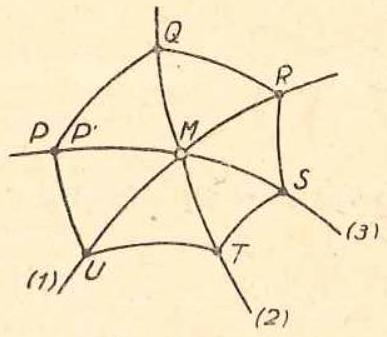
Fig. 1
numerous works, especially at the end of the third decade and in the fourth decade of this century on the theme of "Topological Questions of Differential Geometry".
T. Dubourdieu [4], characterizes tissues with the help of an invariant
T. Dubourdieu [4], characterizes tissues with the help of an invariant
we can always determine these forms so that we have
or
If we note
then
and with
then
is the topological invariant of the weave.
Among the third-order weaves, the hexagonal ones are remarkable, which have the following closure property.
Among the third-order weaves, the hexagonal ones are remarkable, which have the following closure property.
If
G. Thomsen [5] demonstrated that hexagonal weaves are topologically mapped onto three parallel line bundles and J. Dubourdieu [4] showed that the necessary and sufficient condition for a third-order weave to be hexagonal is obtained by canceling the topological invariant
verify when the families of tissues or the differential forms of these families are given. Let us prove a series of theorems related to particular tissues located on surfaces of type (1).
G. Thomsen [5] demonstrated that hexagonal weaves are topologically mapped onto three parallel line bundles and J. Dubourdieu [4] showed that the necessary and sufficient condition for a third-order weave to be hexagonal is obtained by canceling the topological invariant
verify when the families of tissues or the differential forms of these families are given. Let us prove a series of theorems related to particular tissues located on surfaces of type (1).
Theorem I. Given a surface
the necessary and sufficient condition for the tissue formed by the families
to be hexagonal is for the surface to be of the form (1), that is
We can write the differential forms of the families as
The topological invariant has the expression
provided
if
which is precisely the condition of Saint Robert. It follows from this
or
Theorem II. The tissue formed by the contour lines of the surface (1), the curves of highest slope, and one of the families of coordinate curves is hexagonal.
Considering the surface given by equations (2), we find for the considered families, the differential forms
These forms being exact total differentials, it is obvious that they verify condition (8).
Theorem III. The tissue formed by the orthogonal trajectories of the coordinate lines and the lines of greatest slope or the orthogonal trajectories of the family
Theorem III. The tissue formed by the orthogonal trajectories of the coordinate lines and the lines of greatest slope or the orthogonal trajectories of the family
The differential forms of these families are
and verify, however three are taken, condition (8).
Theorem IV. The networks formed by the orthogonal trajectories of the coordinate lines, the lines of greatest slope and the orthogonal trajectories of the family
Theorem IV. The networks formed by the orthogonal trajectories of the coordinate lines, the lines of greatest slope and the orthogonal trajectories of the family
The families of these networks are
where
Noting
which characterize, according to W. Blaschke [3], diagonal networks.
These theorems applied to particular surfaces of the type (1) surfaces give interesting interweavings between families of curves. They are also valid for any surface, but in these cases the families do not contain either the level lines or the lines of greatest slope.
These theorems applied to particular surfaces of the type (1) surfaces give interesting interweavings between families of curves. They are also valid for any surface, but in these cases the families do not contain either the level lines or the lines of greatest slope.
Department of Geometry, University «V. Babes»- Chuj
PROPERTIES OF SPECIAL FLOORS
SHORT CONTENT
The author deals with the class of surfaces of type (1), found in nomographies. They contain, as special cases, rotational surfaces, translational surfaces and second-order surfaces. The author defines then unfolding surfaces of the type (1). Ih parameters-
Czech equations are expressed by formulas (5). Next, some hexagonal fabrics on the considered surfaces are considered, and the families of these fabrics are the intersections of the coordinate planes with the surface and their orthogonal trajectories. For this, the results of Dubourdie [3] are used.
PROPRIÉTÉS DE CERTAINES SURFACES SPÉCIALES
SUMMARY
Dans ce travail, l'auteur s'occupe d'une classe de surfaces du type (1), intervenant en nomographie. Elles comprennée, comme des cas particuliers, les surfaces de rotation, les surfaces de translation et les quadriques. The author then determines the développable surfaces of type (1). Continuing, it examines some hexagonal networks located on the surfaces considered, the families of these networks being the intersections of the coordinate planes with the surface and their orthogonal trajectories. A cette fin, on se sert des résultats de J. Dubourdieu [3].
BIBLIOGRAPHY
- L. Bal, F. Rado, Nomography Lessons. Technical Publishing House, Bucharest, 1956.
- M. Fréchet, Determination of minima surfaces of type
- W. Blaschke, G. Bol, Geometrie der Gewebe. J. Springer, Berlin, 1938.
- G. Thomsen, A topological theorem on curves. Boll. della Unione Mat. Ital., 6, 80-85 (1927).